10/30/09

The Doctrine of Preemptive Bailouts and the Biggest Bailout you haven’t Heard About: The U.S. Treasury Plan C and the $3.5 Trillion You will be Paying

Last week a story which gained very little traction hit the financial newswires.  The U.S. Treasury is working on an internal project informally called “Plan C” which seeks to deal with further problems in the economy before they occur.  The anonymous report came out stating the administration is reluctant to commit any additional money especially to the level mentioned in the report.  However this is a disturbing new development in our bailout nation since this is one of the first times that the U.S. Treasury will try to preemptively deal with a financial problem.

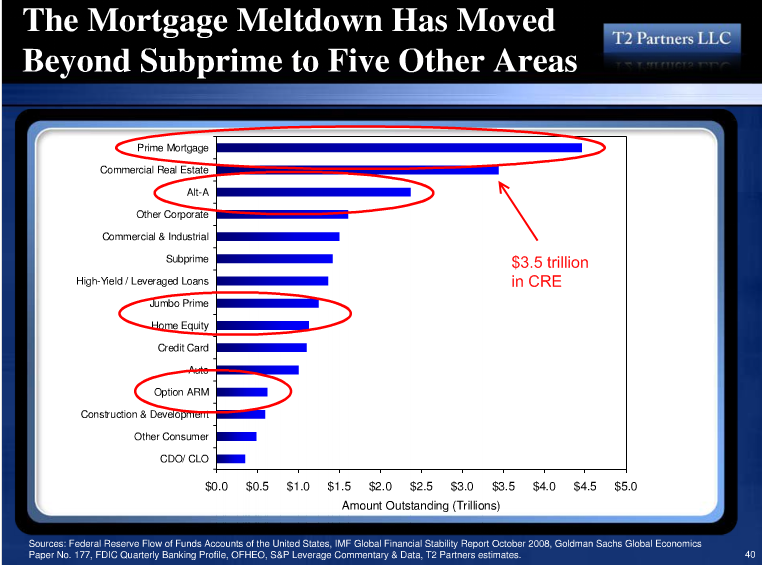
The issues with this Plan C is that it is setup to be a buffer on further deterioration in various loan categories but the big one is commercial real estate.  The commercial real estate market is gigantic and many of those loans are still active:

commerical real estate

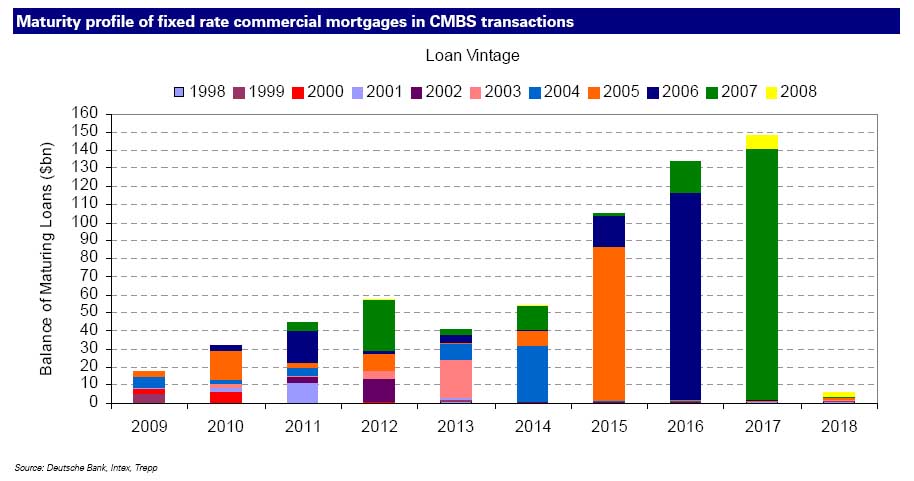
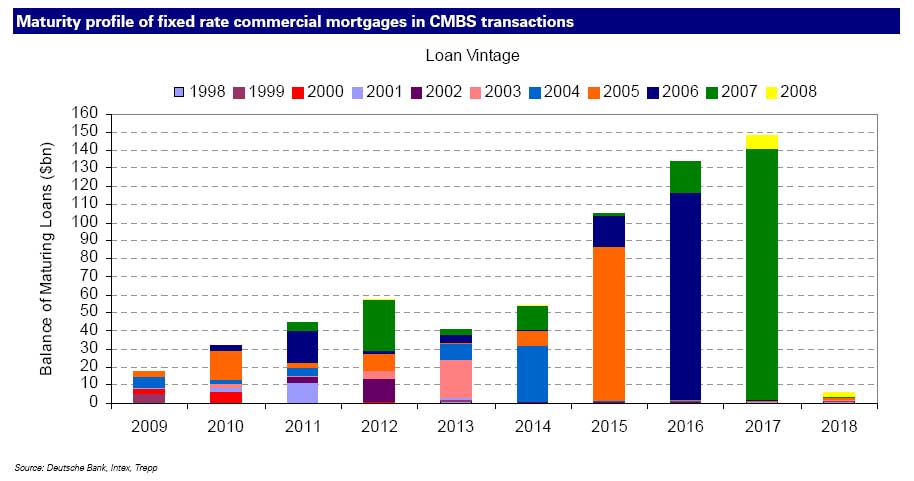
Some $3.5 trillion in commercial real estate loans are out in the market.  The problem is complicated because commercial real estate holders simply rollover their debt into new loans.  That of course has changed since the economy and credit markets have shutdown and many of these properties are now severely underwater.  Take a look at how many loans will be turning over:

mbs
*Source:  ZeroHedge

The amount of maturing loans in commercial real estate will double in 2010 and will continue upward into 2010.  The chart is very clear and this is only for debt in CMBS and not held by regional banks which is over $2 trillion.  This is the next multi-trillion dollar bailout you have yet to hear about.  In fact, while many are discussing a second half recovery higher up officials are already planning a bailout for the commercial real estate industry.  The challenge with this bailout is you are asking a public with 26,000,000 unemployed and underemployed Americans to shoulder the debt of largely speculative plays.  To many it is palatable to bailout the residential real estate market because the public can understand that (even if it may be wrong) or bailing out the 2 large U.S. automakers.  Yet bailing out the commercial real estate market is going to be a political nightmare.

Of course the U.S. Treasury would like you to believe this is merely a precaution but most of the last precautions we have heard about have turned out to be trillions and trillions in full on commitments shouldered by the American public:

“(WaPo) We are continually examining different scenarios going forward; that’s just prudent planning,” Treasury spokesman Andrew Williams said.

The officials in charge of Plan C — named to allude to a last line of defense — face a particular challenge in addressing the breakdown of commercial real estate lending.

Banks and other firms that provided such loans in the past have sharply curtailed lending.
That has left many developers and construction companies out in the cold. Over the next few years, these groups face a tidal wave of commercial real estate debt — some estimates peg the total at more than $3 trillion — that they will need to refinance. These loans were issued during this decade’s construction boom with the mistaken expectation that they would be refinanced on the same generous terms after a few years.

The credit crisis changed all of that. Now few developers can find anyone to refinance their debt, endangering healthy and distressed properties.”

The end of the road has been reached for commercial real estate.  Many regional banks jumped into the commercial real estate market since they had little chance of competing with big subprime and Alt-A mortgage factories like WaMu or Countrywide.  Many regional banks saw this as a way to stay competitive in local regions across the country.  This is a much more diverse problem and the tentacles of the commercial real estate bust will be felt in every state.

These loans were made on strip malls, doctor’s offices, and drive-through restaurants for communities that are hurting from the recession.  This is an enormous amount of debt that is out there that will surely default since there is no way to refinance this debt since many of these projects are literally underwater.  Take a look at the composition of over 8,000 banks and thrifts across the country:

fdic

Factoring in construction and commercial loans you arrive at a stunning 26 percent of all loans in FDIC banks and thrifts.  This is a staggering figure and the U.S. Treasury is well aware of this.  The question isn’t whether there will be major defaults here but who will shoulder the cost?  So far, each consecutive bailout has largely been taken up by the U.S. taxpayer.  The problem of course is the cost of all these bailouts will eventually catch up through a tanking dollar and possibly the long-term viability of our economy.  Plan C is a preemptive bailout on an entire industry.  The reason the government is devising  a plan is that these loans will start going bad in large amounts and they are gearing up on a process of dumping this large mess on the American people.  Yet it is going to be a politically hard sell for many to bailout a strip-mall from some large developer.

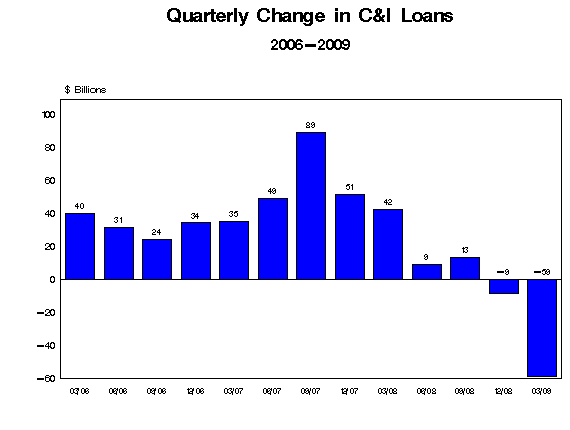
And make no mistake, the market for commercial loans is all but closed:

commerial-loans-quarter

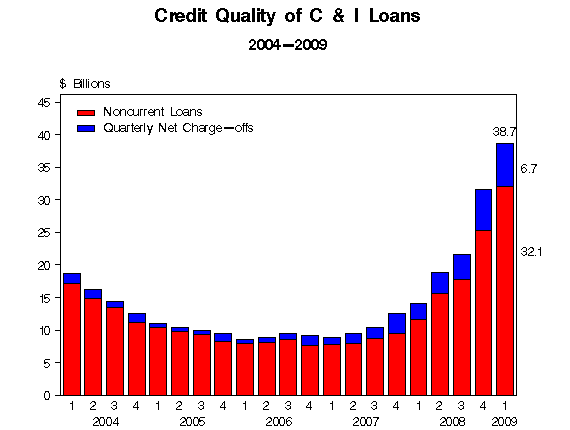
You are reading the above graph correctly.  In the 1st quarter commercial loans fell by a stunning 50 percent on a quarterly basis.  And the amount of bad loans is only growing:

quality-of-loans

If you haven’t heard of Plan C you soon will.  The commercial real estate bailout is the next ploy from Wall Street and the U.S. Treasury.

- Via My Budget 360

Commercial Real Estate Implosion: 67 Percent Fall in Multifamily Starts, Ghost Buildings, $3 Trillion in Debt, 41 Percent Drop in CRE, and Collapse in Rents.

Driving along the highway at night, it is an eerie sight to look at some of the vacant buildings.  The lights are on but the floors are empty awaiting an audience that will never come.  Can it be that commercial real estate, with over $3 trillion outstanding be in worse shape than residential housing?  In a short answer, yes.  I’ll give you a few reasons but the most obvious is that unlike housing, there is rarely a price point where a commercial real estate development will make sense without a sustainable economy.

For example, there are places in Nevada and Arizona that were built with no residences coming and commercial real estate to feed this ghost population.  Another point that makes commercial real estate more problematic is the way commercial projects are financed.  These projects are financed with short-term financing that requires refinancing every 5, 7, or even 10 years.  This stands in sharp contrast to the 30 year fixed mortgages on residential properties.

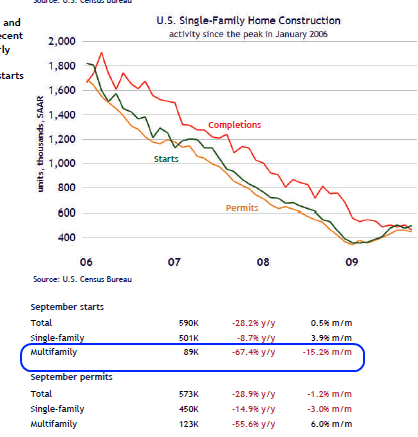
If you really want to see what is happening on the ground, you need to look at housing starts.  After all, these are the builders and should have a better sense of regional niches and demand.  Now their projections are never perfect but they probably have a better sense than say Wall Street which is a few thousand miles from billion dollar construction projects:

housing-starts

Now here is a fascinating case and point.  Single family starts have collapsed.  This is true.  Since the peak, they have been trending lower and lower.  The U.S. Treasury and Federal Reserve even with virtually interest free money cannot stimulate demand in an overbuilt market.  Single family starts are down 8.7 year over year.  But multifamily starts?  Try a stunning 67.4 percent.  Many of these projects are financed with commercial loans and you can see that the demand is virtually gone.  This is one of those unintended consequences that Wall Street and the government fail to notice.

With a tunnel vision focus on propping up the residential housing market, demand for homes has increased.  People are buying up foreclosures and financing their purchase with historically low interest rates courtesy of the Federal Reserve.  The government has also sweeten the pot with the $8,000 poorly targeted tax credit.  But what the Fed fails to see is that vacancy rates were already high for both residential and commercial buildings in the form of say, apartments.  So what happens?  You shift demand from lower priced rental units to homes.  Good news right?  Not at all.  Now what you have is an increase in defaults for commercial loans instead of residential loans because of even higher vacancy rates.

As I mentioned before, the problem with commercial real estate loans is also how they are financed.  Take a look at the turnover profile for the next few years:

mbs
Source:  Zero Hedge

From 2009 to 2010 the amount of MBS maturing is double and it only elevates from that point on.  Who is going to refinance an empty strip mall?  Or a gym with no membership?  What about an office complex with no tenants?  This is the big problem with commercial loans.  Consumer demand has shifted.  With the U.S. dollar tanking the average American is facing higher costs for daily items like food and is seeing some items like cars drop on the secondary market but what is a priority?
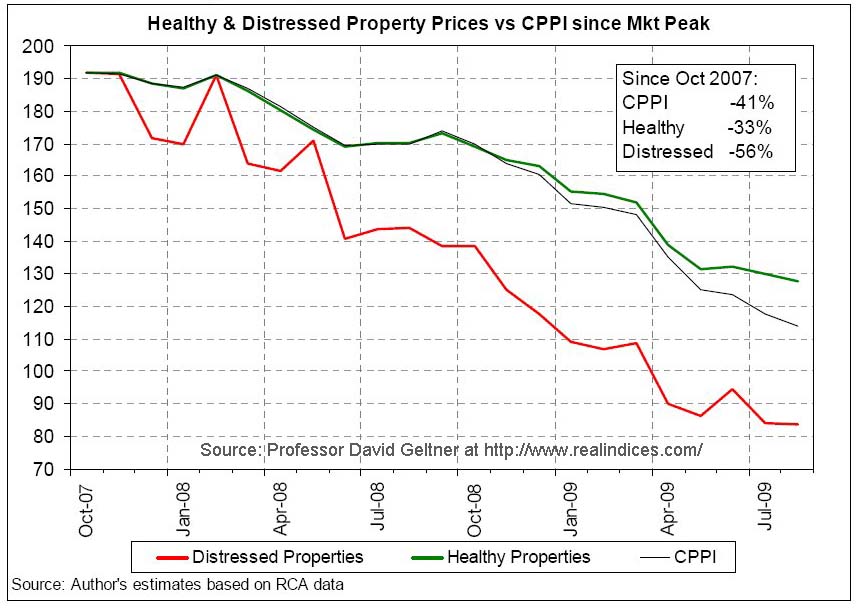
How deep have prices fallen on commercial real estate?  Try 41 percent:

cppihealthydistressed-copy

Unlike residential housing that has stabilized in terms of pricing because of trillions in bailouts, commercial real estate is on the way down.  But make no mistake, the U.S. Treasury has been having off poorly publicized talks about preemptive bailouts in this market.  Even without the talks, the Fed is willing to take everything and anything in exchange for Treasuries.  While the residential housing market peaked in 2005, it looks like CRE peaked in late 2007.  It looks like a two year lag is in the commercial real estate market and this is typical.  These projects take longer to build and usually follow residential projects.

Rents have been falling and this has hurt real estate in Manhattan to apartments in Los Angeles.  In many cases, you would think that a lower price for something is good but this is only reflecting a weaker American consumer that is confronting an unemployment and underemployment rate of 17 percent.  We hear much about this jobless recovery but incomes are low, commercial real estate is a major problem, and the average American is seeing their view of the American Dream become more and more of a mirage.  The only winner seems to be Wall Street.
David Einhorn from Greenlight Capital summed it up well:

“And the neighbors are angry, because at some level, Americans understand that the Washington-Wall Street relationship has rewarded the least deserving people and institutions at the expense of the prudent.  They don’t know the particulars or how to argue against the “without banks, we have no economy” demagogues.  So, they fight healthcare reform, where they have enough personal experience to equip them to argue with Congressmen at town hall meetings.  As I see it, the revolt over healthcare isn’t really about healthcare, but represents a broader upset at Washington.  The lack of trust over the inability to deal seriously with the party goers feeds the lack of trust over healthcare.”

And this leads us to where we are at.  When have we heard prolonged debates regarding commercial real estate or even the bailouts?  We sometimes hear the plutocracy argument that we should have bailed out Lehman Brothers.  Really?  We should have a talk about why we didn’t let more firms fail.
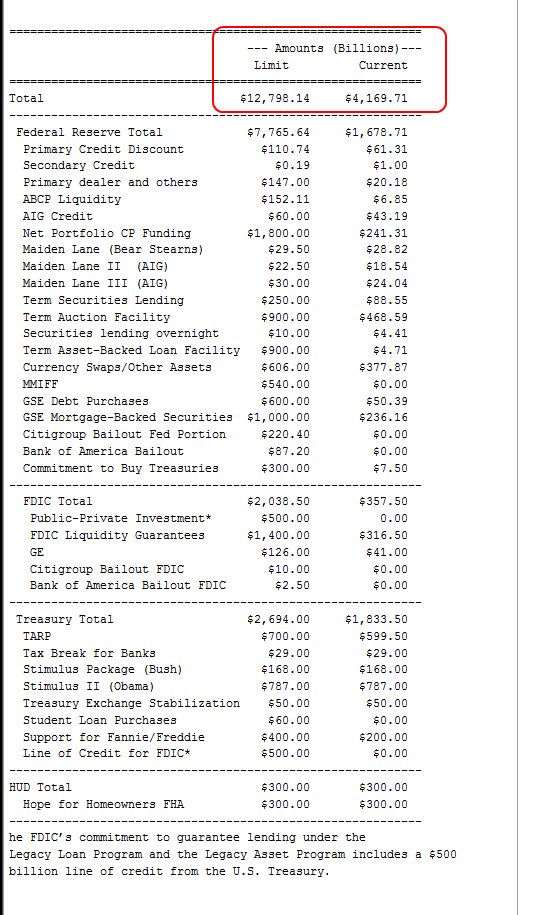
From both parties we get estimates of healthcare reform between $800 billion and $1.2 trillion over a decade.  Commercial real estate has 3 times that sum!  Not one hour of airtime is dedicated to talking about this.  The U.S. Treasury and Federal Reserve have backstopped nearly $13 trillion from the banking sector.  The airwaves should be saturated on a daily basis talking about this and the other bailouts that were never fully vetted.  Don’t believe it?  Here is your bill:

bailout-costs

If there is no resistance, we are going to have another major stealth bailout of the commercial real estate industry.  The U.S. Treasury already has a nice name of “Plan C” for it.  Next time you see those empty buildings keep in mind that you might be paying the mortgage on it pretty soon.

- Via My Budget 360

10/29/09

California AG Wants Pay Option ARM Answers

California attorney general Edmund Brown Jr. today sent a letter to 10 major bank and loan servicers in the state calling for the disclosure of their detailed plans to help certain homeowners manage the drastic payment increases on their pay option adjustable rate mortgages (ARMs).

California homeowners hold nearly 60% of the nation’s pay option ARMs originated between 2004 and 2008, the attorney general’s office said. Nationally, about 1m of these loans are schedule to reset in the next four years, creating higher payments for many loans on the brink of negative equity.

California accounted for more than 25% of the nation’s foreclosure activity in Q309, the attorney general’s office said, with 250,000 homes receiving foreclosure filings in the state. In addition, foreclosure activity increased nearly 20% from 2008 to 2009, and Brown said pay option ARMs could make that problem worse.

“Homeowners with Pay Option ARMs are sitting on ticking time bombs that the lending industry has the power to defuse,” Brown said. “Unless these banks and loan servicers act quickly, hundreds of thousands of mortgages will reset across the state, creating a new wave of foreclosures.”

This is the latest in Brown’s mortgage-related consumer efforts. In October 2008, the attorney general’s office settled an $8.58bn suit against Countrywide Home Loans that claimed the once mighty mortgage lender deceived borrowers by misrepresenting loan terms, loan payment increases, and borrowers’ ability to afford loans.

Brown’s request was made in a letter sent to Bank of America Home Loans & Insurance; Wells Fargo & Company; JP Morgan Chase & Co.; Litton Loan Servicing; ResCap; Ocwen Financial Corporation; OneWest Bank; American Home Mortgage Servicing; Saxon Mortgage Services, Inc.; and Select Portfolio Servicing.

In the letters, Brown asks the lenders and servicers to provide the attorney general with the number of pay option ARMs secured by California homes, the number of those loans that have negatively amortized, and the average dollar amount of that amortization, an explanation of what customer service efforts the lenders and services are taking, including advance notices for borrowers whose loans are about to reset, as well as what modification programs the lenders and servicers plan to offer to borrowers whose loans are about to reset.

- Via Housing Wire

The White House Stupidly Goes To War With Car Website Edmunds.com


It is an odd, and we'd say regrettable, pattern of this White House that it lets itself get dragged down into fights with specific media outlets.

George W. Bush experienced acrimony with the New York Times, but for the most part, other than general frustrations of a conservative administration, complaining about a liberal media, it was no big deal.

But in addition to Fox News, now The White House is going after highly-respected and influential car site Edmunds.com.

They're actually using The White House blog to dispute the site's analysis of Cash-For-Clunkers (via Detroit News).

The post is snarkily titled: "Busy Covering Car Sales on Mars, Edmunds.com Gets It Wrong (Again) on Cash for Clunkers"
Harsh!
Here's the full post:
-----
On the same day that we found out that motor vehicle output added 1.7% to economic growth in the third quarter – the largest contribution to quarterly growth in over a decade – Edmunds.com has released a faulty analysis suggesting that the Cash for Clunkers program had no meaningful impact on our economy or on overall auto sales. This is the latest of several critical “analyses” of the Cash for Clunkers program from Edmunds.com, which appear designed to grab headlines and get coverage on cable TV. Like many of their previous attempts, this latest claim doesn’t withstand even basic scrutiny.

The Edmunds analysis is based on two implausible assumptions:

1. The Edmunds’ analysis rests on the assumption that the market for cars that didn’t qualify for Cash for Clunkers was completely unaffected by this program.
In other words, all the other cars were being sold on Mars, while the rest of the country was caught up in the excitement of the Cash for Clunkers program.  This analysis ignores not only the price impacts that a program like Cash for Clunkers has on the rest of the vehicle market, but the reports from across the country that people were drawn into dealerships by the Cash for Clunkers program and ended up buying cars even though their old car was not eligible for the program.
This faulty assumption leads Edmunds to a conclusion that is at odds with many independent analyses: Edmunds assumption that more than 80% of the payback from Cash for Clunkers would occur in 2009 isn't how many mainstream analyses, including Moody's and IHS Global Insight approach the problem (see pages 5 and 15 of this CEA report [PDF]). In fact, Deutsche Bank recently concluded that “The important takeaway from recent sales trends is that it suggests that there has been minimal 'payback' for the U.S. government’s 'cash for clunkers' program.”

2. Edmunds also ignores the beneficial impact that the program will have on 4th Quarter GDP because automakers have ramped up their production to rebuild their depleted inventories.
Major automakers including GM, Ford, Honda and Chrysler all increased their production through the end of the year as a result of this program, which will help boost growth beyond the third quarter. The actions of private market participants, who would not increase production if they didn’t think demand for their product would be there through the end of the year, is a far better indicator of market dynamics – and one that Edmunds.com conveniently ignores.
Most importantly, this program is helping boost our economy and create jobs now when we need it most. In a comprehensive report, the Council of Economic Advisers estimated that the Cash for Clunkers will create 70,000 jobs in the second half of 2009. The strength of recent auto sales data suggest that, if anything, this projection underestimates the actual impact of the program. CEA’s analysis is transparent and comprehensive, laying out all of its assumptions for the public to understand. Edmunds.com, on the other hand, is promoting a bombastic press release without any public access to their underlying analysis.
So put on your space suit and compare the two approaches yourself:
Seriously, what's the point of this? Clunkers is over. It just makes The White House look thin-skinned, though it's great publicity for Edmunds. And yes, Clunkers massively distorted this morning's GDP number, as we demonstrated here, but we're with Edmunds that it was a giant waste with little long-term benefit.

- Via TBI

Yep, Gun Sales Have Fallen Off A Cliff (RGR)

The economic crisis combined with the election of a potentially anti-gun liberal to the White House acted as a big stimulus for the gunmakers.

But it seems that all that happened was that gun demand got pulled forward, because now sales are totally falling off a cliff.

A reader sends along some recent numbers from Ruger (RGR).If you look at the bottom line -- firearm sales -- it only looks like there was a slight sequential dip. But ignore that.

The number to look at is orders received in 3Q, which were down 80%. Due to their backlog, actual firearms sales only dipped a little, but they've only got a few quarters of that left, and then that's finished. The bubble is popped.

- Via TBI


Economy Grows But Jobless Number Still Soars

The nation's economic pulse is starting to beat more powerfully, but it's still too soon to crack open the champagne, President Obama noted Thursday after new numbers showed the economy grew in the third quarter.

The gross domestic product grew at an annual rate of 3.5 percent, up from a 0.7 percent drop in the second quarter, and "the largest three-month gain we have seen in two years," Obama said at a small business event Thursday.

"This is obviously welcome news and an affirmation that this recession is abating and the steps we've taken have made a difference."

But persistently dismal jobless numbers still dampen any talk of a full recovery in the near future. The Labor Department reported Thursday that weekly numbers for newly laid-off workers fell by 1,000 to a seasonally-adjusted 530,000, less than than the 521,000 government economists had expected.
House Minority Leader John Boehner indicated that's the true measure of recovery.

"I'm pleased that the GDP numbers this morning were up. But the question is, where are the jobs?" he asked.

That's also a sentiment the administration has openly expressed and the president revisited Thursday. "The benchmark I use to measure the strength of our economy is not just whether our GDP is growing, but whether we are creating jobs, whether families are having an easier time paying their bills, whether our businesses are hiring and doing well."

The economy's personal impact on Americans has been the central concern of administration critics, who say people don't feel the economic downturn in abstract GDP terms. They feel it, they say, in their paychecks, or lack thereof.

The administration has tried to show it recognizes this. In remarks to a House hearing Thursday, Treasury Secretary Tim Geithner said the situation on American families is "alive and acute."
Still, compounding Republican concerns is the health care reform bill touted by House Speaker Nancy Pelosi Thursday.

"This bill right here, the Pelosi health care bill, will do nothing more than to kill millions more American jobs," said Boehner, R-Ohio.

Council of Economic Advisers Chair Christina Romer chose to look to the horizon.

"The turnaround in crucial labor market indicators, such as employment and the unemployment rate, typically occurs after the turnaround in GDP."

- Via Fox News

Here It Comes... (Option ARMs)

Hmmmm....
Despite that fact, delinquencies have moved steadily higher with the 30 day + delinquency now reaching close to 50% of all outstanding Option Arms.
"I told you so!"
These loans were never designed to lead to actual home ownership.
They were sold as a means to "buy" a home, but the lenders knew full well that this could never, ever happen given the structure of the note.

These notes were more akin to a levered bet placed on commercial real estate, in that they were worse than the typical commercial "interest-only" loan in their inclusion of a requirement that values continually increase to stay ahead of the negative amortization.
These loans cannot be cured

The typical OptionARM customer was qualified on the initial rate on the minimum payment, which was usually 2%, interest-only.

For a typical $500,000 California or Florida home, this resulted in a monthly payment requirement of roughly $850 (2% of $500,000 is $833 a month.)

The "real rate", however, on the loan was typically around 6 or 7%, and the rest of the principal and interest was "capitalized".  If the amortizing rate was 6% on the note then the P&I for a "full payment" would be $2,982.83, resulting in about $2,100 a month in negative amortization.


If you try to "work these out" and manage to go "to the wall" on the note with a 40 year, 4% amortizing refinance, the note still comes up to $2,082.75 - more than a clean double of the original payment!
The "homeowner", however, can't afford the doubling of the payment.  Further, the house isn't worth $500,000 any more - at best it is worth $300,000, which is a big part of why he stopped paying.
These notes were the worst sort of abuse and they're littering the landscape.  I know people who have them here in Florida and have defaulted, and there are a scad load of them in California.  My prediction originally was that half or more of them would wind up being worth recovery value at best, and this appears to be the case.  Since these were nearly all written in the bubble areas, recovery will be fortunate to be 50% of face value.

How many of these are out there?  Good question.  I have seen numbers from $200 - $500 billion, all from reputable sources.  Why don't we have an accurate number from the banks and Fed on these things?

In the "best case" this is another $50 billion in losses and about 25% of the homes purchased in bubble areas from 2003-2006.  In the "worst case" this is well over another $100 billion in losses and perhaps as much as half of the homes purchased in those areas during the bubble years.

Either way you slice these losses have not been recognized or accounted for nor has their impact on home inventory and price.

How The Home Buyer Tax Credit Inflated The GDP Number


Is the economy really recovering or was today's GDP number just a sign of an economy on government life support?


Ideally, we'd want a recovery led by genuine business activity. But a huge portion of today's GDP number looks like it was a product of government intervention into the economy.

Our chart of the day shows how the government's cash for clunkers program added 1.66 percentage points to the GDP, boosting it from a pathetic 1.89% gain to 3.5%. Add to that at least a portion of the huge gain in residential spending activity. This number jumped a seasonally adjusted 23.4% and was responsible for more than a half-percent to GDP.

How much of that was due to the home buyer tax credit? The National Association of Realtors says that nearly half of the jump in home sales this year was directly attributable to the tax credit. So we probably need to shave at least another 0.25% off GDP.

Now it is good news that these government programs are working. Gains from government intervention are real gains. People building cars subsized by the government are still building cars. And people who sold homes to first time buyers really do get paid for their homes. Just because it is a subsidy doesn't mean it isn't real.

But the gains are just not necessarily signs of a healthy economy.

- Via TBI

CHART OF THE DAY: Cash-For-Clunkers MASSIVELY Distorted GDP

If anyone mentions the just-released 3.5% U.S. third quarter GDP growth, just throw this chart in their face. Cash for Clunkers clearly distorted the U.S. economic figures in an unsustainable fashion.

According to the Bureau of Economic Analysis (BEA), motor vehicle output spiked a seasonally-adjusted 157.6% quarter on quarter. This is completely unprecedented. Vehicle output is clearly going off a cliff next quarter. The question will be how low can the blue line below go.

Next quarter, we won't just be returning to business as usual for auto output. Don't forget that Cash for Clunkers pulled future auto demand, ie. some of Q4 demand, into Q3. Thus Q4 is likely to be very weak since many people who planned to buy a car in Q4 probably took advantage of Clunkers and bought in Q3.

To put this into GDP terms, according to the BEA the spike you see below added 1.66% to the U.S. GDP growth figure reported. Thus without it, GDP growth would have been only 1.89% (3.5% - 1.66%) in Q3.

Now imagine if next quarter the blue line below goes down into negative territory as it did just two quarters ago. Next quarter, not only are we unlikely to get Q3's boost, but motor vehicle output data could subtract from GDP as well. So watch out for the cliff...


- Via TBI

GDP Is..... Better Than Expected?

Oh what a tangled web we weave....
Real gross domestic product -- the output of goods and services produced by labor and property located in the United States -- increased at an annual rate of 3.5 percent in the third quarter of 2009, (that is, from the second quarter to the third quarter), according to the "advance" estimate released by the Bureau of Economic Analysis. In the second quarter, real GDP decreased 0.7 percent.
Looks good, right?
Hmmmm.... or is it?
Motor vehicle output added 1.66 percentage points to the third-quarter change in real GDP after adding 0.19 percentage point to the second-quarter change.
....
Real federal government consumption expenditures and gross investment increased 7.9 percent in the third quarter, compared with an increase of 11.4 percent in the second.
Ok, from this we can compute a few things.
3.5 - 1.66 - (7.9 * 30%) = -0.53%
Now let's adjust for inventories:
The change in real private inventories added 0.94 percentage point to the third-quarter change in real GDP after subtracting 1.42 percentage points from the second-quarter change.
-0.53% - 0.94% = -1.47%.
Ok, that's bad but not catastrophic and is an actual improvement compared to the second quarter.  But....
Current-dollar personal income decreased $15.5 billion (0.5 percent) in the third quarter, in contrast to an increase of $19.1 billion (0.6 percent) in the second.
Personal current taxes increased $4.8 billion in the third quarter, in contrast to a decrease of $119.1 billion in the second.
Eeeeehhh... those are both going the wrong way.  Taxes up, income down.  And...
Disposable personal income decreased $20.4 billion (0.7 percent) in the third quarter, in contrast to an increase of $138.2 billion (5.2 percent) in the second. Real disposable personal income decreased 3.4 percent, in contrast to an increase of 3.8 percent.
That's worse.  A lot worse.  Disposable personal income decreased in nominal terms q/o/q by 5.9% while in real terms (inflation adjusted) it decreased q/o/q by 7.4%!  That is an enormous swing in purchasing power and not in the right direction!
Personal outlays increased $148.2 billion (5.8 percent) in the third quarter, compared with an increase of $8.2 billion (0.3 percent) in the second. Personal saving -- disposable personal income less personal outlays -- was $364.6 billion in the third quarter, compared with $533.1 billion in the second.
The personal saving rate -- saving as a percentage of disposable personal income -- was 3.3 percent in the third quarter, compared with 4.9 percent in the second.
So into decreasing personal income and disposable personal income people tried to spend anyway.  Best guess: most of this was "cash for clunkers", which is the worst sort of "spending" - it is the taking on of more debt by replacing a paid-off car with one that now comes with a shiny (and nasty) payment book.  The Trade: Go long auto repo outfits (aside: as far as I know there are no publicly-traded repo companies.)

Nothing in here I like; to the contrary, this report sucks and on a drill-down appears to be full of outright lies.

Looking inside the data, the "big change" in private domestic investment is all residential fixed - up 23.4%.  I don't believe it.  I've been scouring the homebuilder earnings releases and data, and I don't see the numbers that support this.  An improvement over the ditch-diving of the last many quarters, yes - but a 23.4% increase, a swing of fifty percent from Q2-Q3?  Oh hell no.  Where is it?  It's not in Home Depot's or Lowe's quarterly results, it's not in the homebuilders, and I can't find it in the suppliers (lumber companies, etc) either.  This sort of move would result in monstrous top-line revenue increases reported by firms in this sector and that simply has not happened.
Nor do the export and import numbers look right.  Port of Long Beach and LA anyone?  Those numbers also don't add up - swings of 20-25% in one quarter?  Not reflected in container volumes and freight loadings.  Yet it has to be - how do you get something in or out of here without it going through a port?

Government looks right, both federal and state/local.  The "Obama will cut defense and war spending" folks have to be bashing themselves with a hammer - there's no evidence for that in the data, now three quarters into his administration.  If you're anti-war and "bring the troops home", you may want to re-think whether voting for Barry was a wise decision - he sure as hell hasn't kept that promise.  (Note that I didn't think he would either but that lie sure played well in San Francisco, didn't it?)

Forward the big problem is the deterioration in personal income.  You can't spend what you don't have without credit creation, and that's fallen off a cliff.  The Fed's credit reports continue to come in with huge contractions - this should not surprise, as demanding that banks lend to people who are seeing their income shrink is into the realm of pure idiocy.

The market likes the numbers although a lot of the move - perhaps all of it - is Bucky getting thrown under the bus once again.  

You can't expect the cheerleaders on CNBC to read beyond the headline numbers, and they (once again) did not disappoint in this regard.  The first 20 minutes of "analysis" brought not one mention of the decease in personal income or disposable personal income, yet on a forward basis this is in fact the most important piece of information in the report.  

You cannot have an economic recovery when on a q/o/q basis real disposable income is contracting at a 7.4% annual rate and worse, the spread between nominal and real income is widening, indicating that mandatory purchases such a food, energy and health care - are increasing.

- Via Market Ticker 


Stimulus dollars going to accused contractors

President Obama and members of Congress told federal agencies earlier this year to avoid awarding funds under the American Recovery and Reinvestment Act to contractors with troubled histories of work for the federal government.

But that isn't happening at numerous agencies, a Washington Post analysis shows. So far, 33 federal departments and agencies have awarded more than $1.2 billion in stimulus contracts to at least 30 companies that are ranked by one watchdog group as among the most egregious offenders of state and federal laws.

Government records show that as a group, these contractors have sold defective products, manufactured safety tests, submitted false travel claims and padded contracts with fraudulent fees.
"Even a simple Google search could raise red flags about some contractors' performance," said Rep. Carolyn B. Maloney (D-N.Y.).

Honeywell International, for example, is defending itself against a Justice Department lawsuit accusing it of selling defective shields for bulletproof vests to the Defense and Homeland Security departments, costing the federal government tens of millions of dollars. But that did not prevent the company from winning $2.9 million in stimulus contracts from the Air Force.

On a larger scale, UT-Battelle, a partnership of the University of Tennessee and Battelle Memorial Institute, has been awarded 43 Recovery Act contracts worth more than $331 million by the Department of Energy for work at the Oak Ridge National Laboratory. In every instance, competitive bidding rules were waived, but officials said the contracts were largely extensions of competitively bid work that was already underway at the site.

Obama explicitly warned against awarding contracts without competitive bidding in a memo released to agency heads weeks after he signed the act, saying they create "a risk that taxpayer funds will be spent on contracts that are wasteful, inefficient, subject to misuse." (So far, half of the $16 billion awarded under the stimulus has gone to contractors that did not have to compete for the work.)

The administration followed up on Obama's memo Tuesday, instructing agencies to cut contract spending by 7 percent in the next two years and hire at least 5 percent more contracting officers in the next five years to manage the large contracts. Agencies must also cut 10 percent of their "high risk" or non-competitive contracts this fiscal year.

UT-Battelle was cited in 2005 for serious nuclear safety violations at the former Cold War site. And last year, the inspector general cited the company for using $600,000 in federal money for unapproved expenditures on cigars, wine and gifts, including a pen with a built-in USB flash drive, given to guests at a scientific conference. Officials said the firm has resolved past problems and believes the Recovery Act awards were appropriate.

"UT-Battelle has worked with the Department to address any previous concerns that have been raised about the company," Michael Bradley, a UT-Battelle spokesman, said in a statement.


The Project on Government Oversight, a government watchdog group, compiled data on Honeywell, Battelle and other contractors that have had legal or regulatory issues with federal agencies. For its analysis, The Post compared a list of companies receiving stimulus grants with POGO's data and examined reports from the Government Accountability Office, court records from the Justice Department and other public documents.

In an attempt to curtail contract awards to companies with prior problems, Maloney last year authored a law that requires creation of a government database to track past performance.

The database would include civil and criminal actions in which the contractor lost. None of this information, however, would be made publicly available, and government officials would have to only log and check information. Nothing in the law compels them to use it when awarding contracts.

Honeywell and other large government contractors said using such databases to shape decision-making is simplistic. Business relationships, they said, are uneven. "From time to time, as in all commercial relationships, there are misunderstandings or even disputes between parties that are inevitably resolved," said Honeywell spokesman Peter Dalpe.

Government contract officials said many factors must be considered when awarding work, including a company's expertise. Concerns over federal contracts are acute now because even before the stimulus bill passed, taxpayers in 2008 financed $500 billion in such work, a doubling of the amount spent in 2001.
That figure is expected to climb to at least $525 billion for 2009, and oversight of those dollars will heavily rely on whistleblower reports. With Recovery Act contracts in particular, the public is asked to report any abuse of funds by calling a hotline or filling out an anonymous online form.
Whistleblowers said that for the hotline to work, contractors need to feel a sharper sting when they are caught.

Judith Neal called a hotline and exposed Honeywell for fabricating tests on at least $7 million in ammunition it manufactured and sold in 1987, according to a court finding. She's watched as similar incidents have continued for two decades.

At the time, both Neal, who worked in the company's personnel department, and the Justice Department prevailed in court against Honeywell. However, the federal government secured $2 million from the company and $400,000 in ammunition, not even half the value of the faulty ammunition, records show. Such disparities in cost recoveries continue and are common.

"It is not punitive at all," said Neal, now director of the Tyson Center for Faith and Spirituality in the Workplace at the University of Arkansas. "When you talk about repeat offenders, there are too many profits involved to stop them from doing it again. They just get their hands slapped."

- Via Washington Post

Brother of Afghan Leader Said to Be Paid by C.I.A.


KABUL, AfghanistanAhmed Wali Karzai, the brother of the Afghan president and a suspected player in the country’s booming illegal opium trade, gets regular payments from the Central Intelligence Agency, and has for much of the past eight years, according to current and former American officials.

The agency pays Mr. Karzai for a variety of services, including helping to recruit an Afghan paramilitary force that operates at the C.I.A.’s direction in and around the southern city of Kandahar, Mr. Karzai’s home.

The financial ties and close working relationship between the intelligence agency and Mr. Karzai raise significant questions about America’s war strategy, which is currently under review at the White House.

The ties to Mr. Karzai have created deep divisions within the Obama administration. The critics say the ties complicate America’s increasingly tense relationship with President Hamid Karzai, who has struggled to build sustained popularity among Afghans and has long been portrayed by the Taliban as an American puppet. The C.I.A.’s practices also suggest that the United States is not doing everything in its power to stamp out the lucrative Afghan drug trade, a major source of revenue for the Taliban.
More broadly, some American officials argue that the reliance on Ahmed Wali Karzai, the most powerful figure in a large area of southern Afghanistan where the Taliban insurgency is strongest, undermines the American push to develop an effective central government that can maintain law and order and eventually allow the United States to withdraw.

“If we are going to conduct a population-centric strategy in Afghanistan, and we are perceived as backing thugs, then we are just undermining ourselves,” said Maj. Gen. Michael T. Flynn, the senior American military intelligence official in Afghanistan.

Ahmed Wali Karzai said in an interview that he cooperated with American civilian and military officials, but did not engage in the drug trade and did not receive payments from the C.I.A.

The relationship between Mr. Karzai and the C.I.A. is wide ranging, several American officials said. He helps the C.I.A. operate a paramilitary group, the Kandahar Strike Force, that is used for raids against suspected insurgents and terrorists. On at least one occasion, the strike force has been accused of mounting an unauthorized operation against an official of the Afghan government, the officials said.

Mr. Karzai is also paid for allowing the C.I.A. and American Special Operations troops to rent a large compound outside the city — the former home of Mullah Mohammed Omar, the Taliban’s founder. The same compound is also the base of the Kandahar Strike Force. “He’s our landlord,” a senior American official said, speaking on the condition of anonymity.

Mr. Karzai also helps the C.I.A. communicate with and sometimes meet with Afghans loyal to the Taliban. Mr. Karzai’s role as a go-between between the Americans and the Taliban is now regarded as valuable by those who support working with Mr. Karzai, as the Obama administration is placing a greater focus on encouraging Taliban leaders to change sides.

A C.I.A. spokesman declined to comment for this article.

“No intelligence organization worth the name would ever entertain these kind of allegations,” said Paul Gimigliano, the spokesman.

Some American officials said that the allegations of Mr. Karzai’s role in the drug trade were not conclusive.

“There’s no proof of Ahmed Wali Karzai’s involvement in drug trafficking, certainly nothing that would stand up in court,” said one American official familiar with the intelligence. “And you can’t ignore what the Afghan government has done for American counterterrorism efforts.”

At the start of the Afghan war, just after the 9/11 terrorist attacks in the United States, American officials paid warlords with questionable backgrounds to help topple the Taliban and maintain order with relatively few American troops committed to fight in the country. But as the Taliban has become resurgent and the war has intensified, Americans have increasingly viewed a strong and credible central government as crucial to turning back the Taliban’s advances.

Now, with more American lives on the line, the relationship with Mr. Karzai is setting off anger and frustration among American military officers and other officials in the Obama administration. They say that Mr. Karzai’s suspected role in the drug trade, as well as what they describe as the mafialike way that he lords over southern Afghanistan, makes him a malevolent force.

These military and political officials say the evidence, though largely circumstantial, suggests strongly that Mr. Karzai has enriched himself by helping the illegal trade in poppy and opium to flourish. The assessment of these military and senior officials in the Obama administration dovetails with that of senior officials in the Bush administration.

“Hundreds of millions of dollars in drug money are flowing through the southern region, and nothing happens in southern Afghanistan without the regional leadership knowing about it,” a senior American military officer in Kabul said. Like most of the officials in this article, he spoke on the condition of anonymity because of the secrecy of the information.

“If it looks like a duck, and it quacks like a duck, it’s probably a duck,” the American officer said of Mr. Karzai. “Our assumption is that he’s benefiting from the drug trade.”


American officials say that Afghanistan’s opium trade, the largest in the world, directly threatens the stability of the Afghan state, by providing a large percentage of the money the Taliban needs for its operations, and also by corrupting Afghan public officials to help the trade flourish.

The Obama administration has repeatedly vowed to crack down on the drug lords who are believed to permeate the highest levels of President Karzai’s administration. They have pressed him to move his brother out of southern Afghanistan, but he has so far refused to do so.

Other Western officials pointed to evidence that Ahmed Wali Karzai orchestrated the manufacture of hundreds of thousands of phony ballots for his brother’s re-election effort in August. He is also believed to have been responsible for setting up dozens of so-called ghost polling stations — existing only on paper — that were used to manufacture tens of thousands of phony ballots.
“The only way to clean up Chicago is to get rid of Capone,” General Flynn said.

In the interview in which he denied a role in the drug trade or taking money from the C.I.A., Ahmed Wali Karzai said he received regular payments from his brother, the president, for “expenses,” but said he did not know where the money came from. He has, among other things, introduced Americans to insurgents considering changing sides. And he has given the Americans intelligence, he said. But he said he was not compensated for that assistance.

“I don’t know anyone under the name of the C.I.A.,” Mr. Karzai said. “I have never received any money from any organization. I help, definitely. I help other Americans wherever I can. This is my duty as an Afghan.”

Mr. Karzai acknowledged that the C.I.A. and Special Operations troops stayed at Mullah Omar’s old compound. And he acknowledged that the Kandahar Strike Force was based there. But he said he had no involvement with them.

A former C.I.A. officer with experience in Afghanistan said the agency relied heavily on Ahmed Wali Karzai, and often based covert operatives at compounds he owned. Any connections Mr. Karzai might have had to the drug trade mattered little to C.I.A. officers focused on counterterrorism missions, the officer said.

“Virtually every significant Afghan figure has had brushes with the drug trade,” he said. “If you are looking for Mother Teresa, she doesn’t live in Afghanistan.”

The debate over Ahmed Wali Karzai, which began when President Obama took office in January, intensified in June, when the C.I.A.’s local paramilitary group, the Kandahar Strike Force, shot and killed Kandahar’s provincial police chief, Matiullah Qati, in a still-unexplained shootout at the office of a local prosecutor.

The circumstances surrounding Mr. Qati’s death remain shrouded in mystery. It is unclear, for instance, if any agency operatives were present — but officials say the firefight broke out when Mr. Qati tried to block the strike force from freeing the brother of a task force member who was being held in custody.
“Matiullah was in the wrong place at the wrong time,” Mr. Karzai said in the interview.

Counternarcotics officials have repeatedly expressed frustration over the unwillingness of senior policy makers in Washington to take action against Mr. Karzai — or even begin a serious investigation of the allegations against him. In fact, they say that while other Afghans accused of drug involvement are investigated and singled out for raids or even rendition to the United States, Mr. Karzai has seemed immune from similar scrutiny.

For years, first the Bush administration and then the Obama administration have said that the Taliban benefits from the drug trade, and the United States military has recently expanded its target list to include drug traffickers with ties to the insurgency. The military has generated a list of 50 top drug traffickers tied to the Taliban who can now be killed or captured.

Senior Afghan investigators say they know plenty about Mr. Karzai’s involvement in the drug business. In an interview in Kabul this year, a top former Afghan Interior Ministry official familiar with Afghan counternarcotics operations said that a major source of Mr. Karzai’s influence over the drug trade was his control over key bridges crossing the Helmand River on the route between the opium growing regions of Helmand Province and Kandahar.

The former Interior Ministry official said that Mr. Karzai was able to charge huge fees to drug traffickers to allow their drug-laden trucks to cross the bridges.

But the former officials said it was impossible for Afghan counternarcotics officials to investigate Mr. Karzai. “This government has become a factory for the production of Talibs because of corruption and injustice,” the former official said.

Some American counternarcotics officials have said they believe that Mr. Karzai has expanded his influence over the drug trade, thanks in part to American efforts to single out other drug lords.

In debriefing notes from Drug Enforcement Administration interviews in 2006 of Afghan informants obtained by The New York Times, one key informant said that Ahmed Wali Karzai had benefited from the American operation that lured Hajji Bashir Noorzai, a major Afghan drug lord during the time that the Taliban ruled Afghanistan, to New York in 2005. Mr. Noorzai was convicted on drug and conspiracy charges in New York in 2008, and was sentenced to life in prison this year.

Habibullah Jan, a local military commander and later a member of Parliament from Kandahar, told the D.E.A. in 2006 that Mr. Karzai had teamed with Haji Juma Khan to take over a portion of the Noorzai drug business after Mr. Noorzai’s arrest.

- Via NY Times

Gardasil Researcher Drops A Bombshell

Dr. Diane Harper, lead researcher in the development of two human papilloma virus vaccines, Gardasil and Cervarix, said the controversial drugs will do little to reduce cervical cancer rates and, even though they’re being recommended for girls as young as nine, there have been no efficacy trials in children under the age of 15.

Dr. Harper, director of the Gynecologic Cancer Prevention Research Group at the University of Missouri, made these remarks during an address at the 4th International Public Conference on Vaccination which took place in Reston, Virginia on Oct. 2-4. Although her talk was intended to promote the vaccine, participants said they came away convinced the vaccine should not be received.

“I came away from the talk with the perception that the risk of adverse side effects is so much greater than the risk of cervical cancer, I couldn’t help but question why we need the vaccine at all,” said Joan Robinson, Assistant Editor at the Population Research Institute.

Dr. Harper began her remarks by explaining that 70 percent of all HPV infections resolve themselves without treatment within a year. Within two years, the number climbs to 90 percent. Of the remaining 10 percent of HPV infections, only half will develop into cervical cancer, which leaves little need for the vaccine.


She went on to surprise the audience by stating that the incidence of cervical cancer in the U.S. is already so low that “even if we get the vaccine and continue PAP screening, we will not lower the rate of cervical cancer in the US.”

There will be no decrease in cervical cancer until at least 70 percent of the population is vaccinated, and even then, the decrease will be minimal.

Apparently, conventional treatment and preventative measures are already cutting the cervical cancer rate by four percent a year. At this rate, in 60 years, there will be a 91.4 percent decline just with current treatment. Even if 70 percent of women get the shot and required boosters over the same time period, which is highly unlikely, Harper says Gardasil still could not claim to do as much as traditional care is already doing.

Dr. Harper, who also serves as a consultant to the World Health Organization, further undercut the case for mass vaccination by saying that “four out of five women with cervical cancer are in developing countries.”

Ms. Robinson said she could not help but wonder, “If this is the case, then why vaccinate at all? But from the murmurs of the doctors in the audience, it was apparent that the same thought was occurring to them.”

However, at this point, Dr. Harper dropped an even bigger bombshell on the audience when she announced that, “There have been no efficacy trials in girls under 15 years.”


Merck, the manufacturer of Gardasil, studied only a small group of girls under 16 who had been vaccinated, but did not follow them long enough to conclude sufficient presence of effective HPV antibodies.

This is not the first time Dr. Harper revealed the fact that Merck never tested Gardasil for safety in young girls. During a 2007 interview with KPC News.com, she said giving the vaccine to girls as young as 11 years-old “is a great big public health experiment.”

At the time, which was at the height of Merck’s controversial drive to have the vaccine mandated in schools, Dr. Harper remained steadfastly opposed to the idea and said she had been trying for months to convince major television and print media about her concerns, “but no one will print it.”

“It is silly to mandate vaccination of 11 to 12 year old girls,” she said at the time. “There also is not enough evidence gathered on side effects to know that safety is not an issue.”

When asked why she was speaking out, she said: “I want to be able to sleep with myself when I go to bed at night.”

Since the drug’s introduction in 2006, the public has been learning many of these facts the hard way. To date, 15,037 girls have officially reported adverse side effects from Gardasil to the Vaccine Adverse Event Reporting System (VAERS). These adverse reactions include Guilliane Barre, lupus, seizures, paralysis, blood clots, brain inflammation and many others. The CDC acknowledges that there have been 44 reported deaths.

Dr. Harper also participated in the research on Glaxo-Smith-Kline’s version of the drug, Cervarix, currently in use in the UK but not yet approved here. Since the government began administering the vaccine to school-aged girls last year, more than 2,000 patients reported some kind of adverse reaction including nausea, dizziness, blurred vision, convulsions, seizures and hyperventilation. Several reported multiple reactions, with 4,602 suspected side-effects recorded in total. The most tragic case involved a 14 year-old girl who dropped dead in the corridor of her school an hour after receiving the vaccination.

The outspoken researcher also weighed in last month on a report published in the Journal of the American Medical Association that raised questions about the safety of the vaccine, saying bluntly: "The rate of serious adverse events is greater than the incidence rate of cervical cancer."

Ms. Robinson said she respects Dr. Harper’s candor. “I think she’s a scientist, a researcher, and she’s genuine enough a scientist to be open about the risks. I respect that in her.”

However, she failed to make the case for Gardasil. “For me, it was hard to resist the conclusion that Gardasil does almost nothing for the health of American women.”


- Via The Bulletin

10/27/09

Peter Schiff on Fast Money CNBC 27 Oct 2009

Glenn Beck on Obama's Redistributive Change: Nancy Pelosi Said What?! Who Pays for 'Public Option'?

Iran opens exchange to trade oil, products-ISNA

Iran, OPEC's second-biggest oil producer, launched its international oil exchange on Monday to buy and sell crude, oil products and petrochemical products, Iran's student news agency ISNA reported.


"The international exchange hall of crude, oil products and petrochemical goods of Iran was inaugurated. Our aim is to shift oil market trade focus in the region to the Kish Island," said Economy Minister Shamseddin Hosseini at the inauguration ceremony, ISNA reported.

The bourse, based on the Gulf economic free zone island of Kish, has been planned for years but had faced repeated delays. The first phase of the exchange for trading oil products was inaugurated in February.

When plans were first mooted, some analysts speculated Iran might use it to undermine the importance of the U.S. dollar by pricing crude in euros or other currencies.

The report did not specify the currency in which trading would take place.

Iran wants to deregulate prices of petrochemicals and other oil products and create more transparency as part of a privatisation drive, aimed at attracting more foreign investment into the country's oil industry.


But investors have shown limited interest mainly because of international sanctions imposed against Iran over its disputed nuclear programme, which the West fears is a cover to build nuclear arms, Iran denies this.

Iran is under U.S. and U.N. sanctions over its nuclear row with the West.

Oil Minister Masoud Mirkazemi, a close ally of hardline President Mahmoud Ahmadinejad, has promised to reinvigorate the Iranian hydrocarbon sector.

He has also signified Iran's need for foreign investment to develop its oil and gas industry. Iran lacks technical capabilities or funds to proceed with its energy projects.

Iran has struggled for years to develop its energy sector and now has to contend with an international lack of credit, as well as the sanctions.

Iran's petrochemical capacity expansion is likely to mainly focus on the rapid expansion programme of the country's refining capacity.

The Islamic state lacks sufficient refining capacity to meet its gasoline needs, leaving it potentially vulnerable to any Western sanctions targeting such trade.

- Via Reuters

Time to bomb them.

Consumer Confidence in U.S. Unexpectedly Decreases

Confidence among U.S. consumers unexpectedly fell in October for a second month as Americans fretted about a lack of jobs.

The Conference Board’s confidence index dropped to 47.7 from a revised 53.4 in September, a report from the New York- based private research group showed today. A measure of employment availability deteriorated to a 26-year low.

Mounting unemployment threatens to restrain consumer spending entering the Christmas-holiday shopping season. Without a sustained rebound in the biggest part of the economy, the emerging recovery may fall short of expectations.

“There really isn’t any scope for us to see sustained gains in consumer spending for quite some time,” said Joshua Shapiro, chief U.S. economist at Maria Fiorini Ramirez Inc., a New York forecasting firm. “The labor market remains very weak.”

Stocks dropped after the report, erasing earlier gains, on concern consumers will cut back. The Standard & Poor’s 500 Index was down 0.2 percent to 1,065.05 at 10:21 a.m. in New York. Treasury securities rallied, pushing the yield on the 10-year note down to 3.52 percent from 3.56 percent late yesterday.

Economists forecast confidence would increase to 53.5 from a previously reported 53.1 for September, according to the median of 74 projections in a Bloomberg News survey. Estimates ranged from 48 to 57.

Home Prices Firm 

An earlier report today showed home prices in 20 U.S. cities rose in August for a third straight month. The S&P/Case- Shiller home-price index climbed 1 percent from the prior month on a seasonally adjusted basis, after a 1.2 percent increase in July. Compared with a year earlier, prices were down 11.3 percent, less than the median forecast of economists surveyed.

The Conference Board’s measure of present conditions dropped to 20.7, the lowest level since February 1983. The gauge of expectations for the next six months decreased to 65.7 from 73.7.
The share of consumers who said jobs are plentiful dropped to 3.4 percent from 3.6 percent. The proportion of people who said jobs are hard to get increased to 49.6 percent, the highest level since May 1983, from 47 percent.

The proportion of people who expect their incomes to rise over the next six months decreased to 10.3 percent from 11.2 percent. The share expecting more jobs fell to 16.3 percent from 18 percent.

Less Spending 

Consumers “remain quite pessimistic about their future earnings, a sentiment that will likely constrain spending during the holidays,” Lynn Franco, director of the Conference Board Consumer Research Center, said in a statement.

Government reports have shown that while companies are slowing the pace of firing they are reluctant to hire. The U.S. has lost 7.2 million jobs since the recession began in December 2007.


Caterpillar Inc. said Oct. 26 it has started rehiring and expects to return a portion of its laid-off employees to jobs as demand increases in the coming months. Even so, while 550 U.S. employees have returned or will return to work before the end of next year, about 2,500 idled U.S. workers are being told they won’t get their jobs back and will be offered a separation package.


“It’s important to remember that we are not close to the record-breaking demand we experienced from 2004 through 2008,” Chief Executive Officer Jim Owens said in a statement.

Buying Plans 

Buying plans for automobiles, homes and major appliances within the next six months all decreased this month, today’s report showed.

Today’s report mimics a decline seen in the Reuters/University of Michigan preliminary index of consumer sentiment issued earlier this month.

Economists say the Conference Board’s index tends to be more influenced by attitudes about the labor market.

Consumer spending probably increased at a 3 percent pace in the third quarter, according to the median projection of economists ahead of the gross domestic product report due in two days. Demand will ease to a 1 percent growth rate the final three months this year and then may accelerate to a 1.5 percent rate in the first quarter, according to median forecasts in a Bloomberg News survey earlier in October.
J.C. Penney Chief Executive Officer Myron Ullman told analysts Oct. 23 while the consumer is “still under enormous pressure,” the company is “starting to see some stabilization and some modest improvement in traffic.”

Fed Regions 

Most Federal Reserve district banks saw “stabilization or modest improvements” in areas including housing and manufacturing in September and earlier this month, according to the Beige Book business survey released Oct. 21. The report was issued two weeks before the central bank’s next monetary policy meeting and cited continued “weak or mixed” labor markets.

“Reports of gains in economic activity generally outnumber declines, but virtually every reference to improvement was qualified as either small or scattered,” the Fed said last week.

- Via CNBC

10/26/09

FDIC Chair Sheila Bair (Video After the Jump)

Before she appeared at the American Bankers Association annual convention today, Federal Deposit Insurance Corporation head Sheila Bair addressed protesters at the conference.

(Check out HuffPost's coverage of the protests here.)

Bair said she "strongly supports" the creation of a consumer financial protection agency, which would shield Americans from confusing credit card and mortgage offers. Bair also expressed regret that existing regulations hadn't done more to prevent the crisis.
Here's Bair:
"In looking at indecipherable credit card statements and documents, mortgages you can't understand and APRs from payday loans and high overdraft fees, I don't see how anyone can say we've done a good job protecting consumers from financial services."
Bair also added, "It's time to put an end to the 'too big to fail' doctrine... Yes, no more bailouts, no more bailouts!"


9 Signs of America in Decline

The sky isn't falling, exactly. America isn't on a fast track to irrelevance. Even in a state of total neglect, we could probably shamble along as a disheveled superpower for a few more decades.

But all empires end, and the warning signs of American decline seem to be blinking more consistently. In the latest annual "prosperity index" published by the Legatum Institute, a London-based research firm, the United States ranks as the ninth most prosperous country in the world. That's five notches lower than last year, when America ranked No. 4. The drop might seem inconsequential, especially in the midst of a grueling recession—except that most of the world has endured the same recession, and other countries are bouncing back faster.

China and India have recovered smartly from the recession, for example. Brazil seems to be barreling ahead. Australia is growing faster than expected, prompting worry among government officials who fear they may have overstimulated the economy. The United States, meanwhile, is muddling through a weak, jobless recovery, and we have a lot of problems that could make prosperity feel elusive for a long time.
[See 4 problems that could sink America.]

Real household income in America has flat-lined, for instance, which means many middle-class families are barely keeping up with inflation. The exploding federal deficit hamstrings the government's ability to help. Healthcare is too expensive, America's manufacturing base is eroding, and two open-ended foreign wars are draining the national treasury. This is not a recipe for building national wealth.

There are still millions of diligent, innovative Americans who could help the nation dig out of its hole. But overall, the American population is falling behind, by a variety of measures. Here are some of them:

Jobs. The International Monetary Fund predicts that the U.S. unemployment rate will be 9.3 percent for all of 2010. That's lower than in some European nations, but it's higher than in Canada and a lot worse than most countries in Scandinavia and Asia. Overall, the U.S. unemployment rate is about average for advanced economies and likely to stay that way. It could be worse, but middling job creation isn't a sign of global leadership.
[See 7 ways to survive the jobless recovery.]

Economic growth. The IMF also predicts that the U.S. economy will grow 1.9 percent in 2010. That's a tad better than the average for all advanced economies, but at least 10 developed nations will grow faster. Woo-hoo. Three cheers for mediocrity.

Poverty. The U.S. poverty rate, about 17 percent, is third worst among the advanced nations tracked by the Organization for Economic Cooperation and Development. In that sample, only Turkey and Mexico are worse.

Education. American 15-year-olds score below the average for advanced nations on math and science literacy. But don't worry, our nation's future leaders are still ahead of their peers in Mexico, Turkey, Greece, and a few other places.

Competitiveness. In the latest global competitiveness report from the World Economic Forum, the United States fell from No. 1 to No. 2. Sure, let's console ourselves that the No. 1 country, Switzerland, is a tiny outlier nation and that getting bumped from the top spot doesn't really mean anything. Add an asterisk, and we're still No. 1.
[See 5 myths about the economic "recovery."]

Prosperity. The most prosperous nations, according to the Legatum report, are Finland, Switzerland, Sweden, Denmark, and Norway. These fairly homogenous European countries are the teachers' pets of global rankings, often appearing near the top because of right-sized economies and a relatively small underclass. For a huge economy like America's, a No. 9 ranking is still respectable. And part of the drop from last year's No. 4 spot is a change in methodology that puts more emphasis on the health and safety of citizens. Still, in the index's subrankings, the United States isn't even in the top 10 for economic fundamentals, safety and security, or governance. We should do better.

Health. In the Legatum study, the United States ranks 27th for the health of its citizens. Life expectancy in America is below the average for 30 advanced countries measured by the OECD, and the obesity rate in America is the worst among those 30 countries, by far. And, of course, we spend far more on healthcare per person than anybody else—but get no bang for the extra buck.

Well-being. In the United Nations' Human Development Index, which attempts to measure the overall well-being of citizens throughout the world, the United States ranks 13th, one notch lower than in the prior set of rankings. Norway, Australia, Iceland, and Canada are at the top.
[See 4 countries with better healthcare than ours.]

Happiness. The United States ranks 11th in the OECD's measure of "life satisfaction"—behind Denmark, Finland, the Netherlands, and other usual suspects. That's not bad, but the United States is one of only four countries where life satisfaction is going down, not up. The other downer nations are Portugal, Hungary, Canada, and Japan. Plus, the research behind these rankings predates the recession, so it's likely that Americans are a lot less satisfied these days.


The overall portrait of America isn't exclusively gloomy, and in some areas we still seem to have an important edge. The Legatum prosperity index, for example, ranks America first for entrepreneurship and innovation. And in a GfK Roper survey of how nations rate as global "brands," America rocketed from No. 7 in 2008 to No. 1 in 2009, largely because the world cheered the election of Barack Obama as U.S. president. But a brand-name leader can't just strong-arm his nation back to greatness. He needs a lot of help from educated, healthy, and employed citizens determined to spread the wealth.

- Via USN
Share/Bookmark